Cruises on Crystal Still Sparkle
 By Robert W. Bone
My affinity for Crystal Cruises began in 1990, about four days before the first ship, Crystal Harmony, made its maiden call in Los Angeles. I was living in Honolulu, which was the Harmony's first stop after leaving Japan, where it was built. I hurried down to the dock and talked my way on board. After scoring a nice lunch in the dining room, I managed an exclusive interview with the ship's cruise director, who spoke enthusiastically about the modern facilities on his brand-new ship.
My article based on this experience was carried a couple of days later in several newspapers, including those in San Diego and Los Angeles, scooping news of the actual arrival of the ship to its new West Coast headquarters.
The most surprising fact about the Crystal Harmony at the time was that it was a Japanese-owned and Japanese-built ship which did not in the slightest seem Japanese. This vessel, and the ships that followed—Crystal Symphony and Crystal Serenity—were designed and built in the European maritime tradition, but designed to attract the American market. The official ship's language was English, although as on most cruise ships, the crew came from all over the world.
Crystal ships are not superliners. Generally speaking, they carry around 1,000 passengers, considerably fewer than today's leviathans that accommodate two or three times that number. I find these medium-sized ships sizable enough to be luxurious; small enough to never feel crowded.
Over 20 years I have traveled five times on the three Crystal ships. This includes the Harmony from London to Norway and later from Honolulu to New Zealand. Then I was on the Symphony to the Baltic Sea, and the Serenity in the Mediterranean. Today there are only two ships in the fleet, the Harmony having been sent home in 2005 to be renamed and reconfigured for the Japanese market.
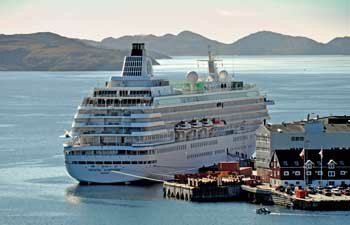
In fall 2010, my wife and I sailed on the Symphony again, this time from Dover, England, to Dublin, Ireland; Reykjavik, Iceland (pictured above); Nuuk, Greenland; Halifax, Nova Scotia; then disembarking in Brooklyn, N.Y.
We were happy to see that the things we always liked about Crystal had remained in place: glamour without glitz, dignity without stuffiness, efficiency without regimentation. And, of course, really top-notch dining in three restaurants—the main dining room, plus two specialty restaurants, Prego, for Italian food, and Silk Road, specializing in Asian fare. There is also a casual Lido deck café for all three meals.
Typically, our two-week adventure in the North Atlantic included three "formal" nights, when passengers at dinner and in all public areas are expected to dress as they might for a presidential banquet or a debutante ball—tuxedos for the men and ball gowns for women. (Dark suits and cocktail dresses are also acceptable.) This is a stylish tradition that has been dropped in many cruise ships.
In the same conservative spirit, Crystal has not succumbed to the trend to install climbing walls, wave machines, water slides or other far-out diversions that have led some critics to size up large modern cruise ships as seagoing amusement parks. Still, the Crystal Symphony has two pools, a spa, fitness center, casino, two showrooms, live entertainment, a library and several bars and lounges. We attended lectures, language classes, computer lessons, fitness programs and well-designed shore excursions and other activities—enough to satisfy almost anyone's mental or physical sense of enrichment.
And unlike most other ships, which today rely only on stateroom TVs for movies, there is even a motion picture theater tucked away somewhere on board. Our only criticism was one that applies to nearly all cruise ships today: the dubious tradition of the "champagne art auction." This is the only event which we never attend. Unlike in the casino, there are few winners at a shipboard art auction, except for the concessionaire who runs the thing.
Between our two Symphony experiences, the ship went through several upgrading procedures—$25 million, I was told. These included improvements in both the staterooms and public areas.
I made a point of meeting and talking with both the captain and the hotel manager, the two most important officers on a cruise ship. The captain is in charge of navigation, the running of the ship and safety of the passengers. Practically his only other duty is to be a sort of father figure who hosts at least one formal reception shortly after the beginning of a voyage.
On our recent cruise to Iceland and Greenland, the captain was Ralf Zander, who has captained cargo vessels and cruise ships. He said he vastly prefers the latter. "You don't get all this fancy food on a freighter!" he laughed.
And he also enjoys the social aspect of being a cruise ship captain. "I met my wife on board," he said. "She was working on the ship. It was a genuine shipboard romance."
The hotel manager is responsible for everything else—staterooms, dining and entertainment. If a passenger has a complaint, the hotel manager is the guy to see. On the Symphony, this job is handled by Herbert Jaeger, who says he seldom has to deal with that kind of problem. "On these ships, we have a very special clientele," Jaeger told me. "They come to us for enrichment," he said. "And we always have the best lecturers and teachers, too."
I like most cruise ships, but there's a special sparkle on Crystal almost making it seem like a multifaceted jewel sailing the high seas.
Robert W. Bone, author of several guidebooks, now lives near San Francisco.
Photo © Robert W. Bone
More from CruiseDiva.com:
Crystal Cruises Cruise Line Profile
Crystal Cruises - Cruise Reviews
Articles & Advice
Cruise Reviews
Cruise Line Profiles