The Magic of the Galapagos Islands
by Stewart B. Nelson, Ph.D.
 |
|
Lammer Law
|
Through the centuries, many words have been used to describe the uniqueness of the Galapagos Islands, from "bewitched" and "enchanted" to Charles Darwin's "living laboratory." Birthed by underwater volcanic eruptions more than 6 million years ago, they remained an uninhabited outpost of nature until stumbled upon by the Spanish in the 16th century. Since that accidental discovery, the islands have been trod by pirates, whalers, adventurers, scientists, military servicemen, fishermen and, now, about 18,000 permanent residents and 70,000 tourists a year. In 1968 the Ecuadorian government acknowledged the immense ecological significance of this oceanic archipelago and, with limited exceptions, declared it a national park. A visit to the Galapagos Islands, to see its amazing fauna and flora and geology and to learn its fascinating history, is a magical experience and one which we treasure and enjoy sharing.
First, let's deal with some common misconceptions. Cruise ships are not allowed in the Galapagos Islands. Only licensed Ecuadorian boats are permitted and the Galapagos National Park Service controls the number. While most boats carry less than 50 guests there are a handful that accommodate up to 90 passengers. The Galapagos Islands are 600 miles from the Ecuadorian mainland and visitor's travel from either Quito or Guayaquil on Boeing 727's operated by Ecuador's TAME Military Airline. Yes, there is an airport in the Galapagos Islands, in fact two of them, on the islands of Baltra and San Cristobal. There are 13 major islands, 6 smaller ones and scores of islets but only four of the islands are allowed permanent settlements. The landscape and wildlife vary among the islands so to see it all requires at least five, but preferably seven, days.
Since the Galapagos Islands are principally a national park, all boats must carry certified guides and, because the guide-tourist ratio is controlled, the bigger the boat the more guides. Finally, there is the matter of the oil spill that occurred in January 2001 when the fuel tanker Jessica ran aground in San Cristobal harbor. This incident made worldwide news but most of the refined fuel oil was quickly recovered and much of the rest was carried seaward by the winds, where it soon evaporated. Granted, luck was a significant factor but the spill served as a stark reminder of the fragility of the Galapagos Islands, one of our world's few remaining ecological jewels.
 |
|
Eclipse
|
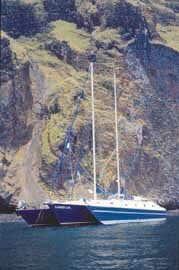
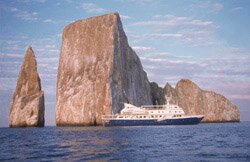
The Galapagos Islands, a World Heritage Site, straddles the Equator so a visit can be planned for almost anytime of the year. There are many tour companies operating in the islands but our choice, based on a seven-day excursion, was Quasar Expeditions USA. Besides owning and operating their own boats, it is recognized both for the upscale quality of their vessels and the outstanding service on board. The Quasar Expeditions fleet consists of eight boats ranging from 8 to 48 passengers. We debated among one of the smaller vessels and the 48-passenger ECLIPSE, but finally decided on the 16-passenger LAMMER LAW. Underscoring the popularity of these boats, we were fortunate to get the last available cabin and that was making a reservation four months before our planned March sailing.
From Miami International Airport it is a four-hour, non-stop flight to Quito, Ecuador's capital. Rich in Inca and Spanish history, Quito is a United Nations World Heritage Site and we had scheduled two days at the end of our Galapagos adventure to do some sightseeing. Those two days would later be extended to a full seven days as we discovered the wondrous diversity and easy accessibility of the Ecuadorian mainland, but that's another story. One great convenience was the fact that Ecuador recently adopted the U.S. dollar as its currency so there was no bother with money exchange or conversion rates.
Quito offers several deluxe hotels, the newest being the three-year old Marriott, which is where we stayed. An excellent steak dinner at the hotel cost was $8.00 - the U.S. dollar buys a lot in Ecuador! The next morning we again met our Quasar Expeditions escort who accompanied us to the airport for our flight to the Galapagos Islands with an intermediate stop at Guayaquil, Ecuador's biggest city. From Quito to Guayaquil was less than 45-minute flying time and from Guayaquil to Baltra less than two hours. The airfield on the small island of Baltra was built by the United States Navy at the beginning of World War II to meet any Japanese attack on the Panama Canal. At the end of the war it was given over to Ecuador. At the Baltra airport you pay your Galapagos National Park entrance fee and for everyone else the fee is $100 and it's a cash only system. We had affixed to our baggage the LAMMER LAW color-coded luggage tags so it was easy to spot fellow passengers and equally easy for our naturalist guide to round us up. Although small, the airport is replete with souvenir shops, both inside and outside of the one terminal building. With assurances that everything would still be there one week later we proceeded to board a bus for a short 10-minute ride to the opposite side of the island and our waiting boat.
Besides the LAMMER LAW, four other Quasar Expeditions boats were awaiting passengers, including the ECLIPSE. We later had the opportunity to briefly visit this vessel and we were certainly impressed with its casual elegance. One of the advantages of a small vessel, which requires only one naturalist guide, is that you function as a group, both on the boat and ashore. Of course you can always find some spot on the deck for a bit of quiet time. 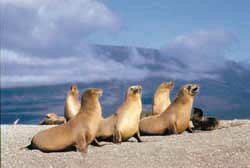 Of our 14 fellow passengers, 4 were from England, 4 from Canada (Toronto) and 4 from the U.S. (Colorado and Florida). After unpacking, which was easily accomplished as the attire was always casual, we assembled in the lounge and were introduced to the boat's captain and staff. When we completed a round of self-introductions and a safety drill, we proceeded to a delicious light meal. One hour later our adventure began as we boarded inflatable boats (locally called pangas) and made our first landfall on North Seymour Island.
Walking along the trails we gazed in wonder at the blue-footed boobies, swallow-tailed gulls and frigate birds. We watched the blue-footed booties doing their foot stomping mating dance but it was the male frigate birds that put forth the most elaborate display. Sitting on shrubs or low-growing trees, they inflated the huge red pouches on their chests, flapped their wings and plaintively called to any female flying overhead. Paying us no mind were the marine iguanas warming themselves in the sun. Sea lions bounded in and out of the water and slept soundly on the shore. Upon returning to our landing site we found that a young sea lion asleep in our pile of life jackets. The wildlife on the Galapagos Islands, so long undisturbed by humans, has no inherent fear and is easily approached. But one hard rule is no touching. Our perplexed guide finally decided to try removing the life jackets one by one from the bottom of the pile. As the pile kept decreasing the obviously disgruntled youngster wallowed off grunting his displeasure at being disturbed.
Every day brought more excitement as we trekked the different islands and encountered giant tortoises, land iguanas, lava lizards, red-footed boobies and flightless cormorants. Most afternoons we went on snorkeling excursions. Curious sea lions came eyeball-eyeball before dashing away. Galapagos penguins - who in the distant past rode the cold Humboldt Current north from Antarctica - sped by like little torpedoes. Turtles glided beneath us and in some locations we spied the occasional shark and manta ray.
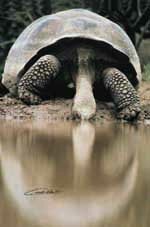 From the time we embarked the LAMMER LAW and disembarked seven days later, we made only one visit to an inhabited destination, the town of Puerto Ayora on Santa Cruz Island. This was an important place because it is the location of the Charles Darwin Research Station. Here we listened to the work being done to preserve, restore and protect the Galapagos Islands. We saw the breeding pens for the giant tortoises, each pen dedicated to the particular type of tortoise that evolved on specific islands. Researchers are also beginning to breed marine iguanas. The greatest threat to the indigenous plants and animals is that of human-introduced species. For example, goats - originally released by the early sailors who wanted to ensure a future food source - can strip an area of its vegetation. Cats and dogs that have become wild are also enemies of the native wildlife. Many efforts are underway to control, and possibly even to eradicate, these destructive threats. The giant tortoise, Lonesome George, is housed at the Charles Darwin Research Station. He is the last male of his species from the island of Pinta. Unfortunately no female survives so, when Lonesome George expires, the Pinta Island species of tortoise will become extinct.
Our Galapagos Islands expedition with Quasar Expeditions came to an end too quickly. However, we took away many rolls of film to be developed and invites from our sailing companions to come visit. Unquestionably, the time we spent in the Galapagos Islands and in exploring the mainland of Ecuador has merely whetted our ecotourism appetite to return.
Quasar Expeditions’ website: www.Galapagosexpeditions.com
Photographs courtesy of Dr. Stewart B. Nelson© & Quasar Expeditions©
More from CruiseDiva.com:
Articles & Advice
Cruise Reviews
Cruise Line Profiles