Ship Size ~ What does it matter?
by Linda Coffman, with Armand Mantia
Why size matters
 |
|
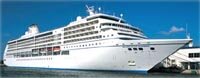
Mid-size Seven Seas Mariner seems "just right" at 48,000 tons
|
Don't let anyone convince you that size doesn't matter in terms of your overall cruise experience. Ship selection is possibly one of your most important decisions and your lifestyle and expectations should be major considerations when making this choice. This is one instance where size really matters and can make or break your vacation.
Entertainment, activities, dining, and even ports of call can and do differ based on a vessel's size. It stands to reason that the larger the ship, the more room there is for amenities like alternative dining venues, huge show lounges and casinos, multiple swimming pools with water slides, and spa facilities. On the other hand, there are intriguing ports of call that only the smaller cruise ships can visit because of docking or tendering considerations. Keep your priorities in mind while you are examining cruise line brochures.
Large Ships - Range from approximately 70,000 tons and up. These are the megaships that include the features modern passengers have come to associate with a cruise. Look for non-stop activities designed for all interests, high energy Las Vegas or Broadway music revues with sophisticated lighting and dazzling costumes, a variety of restaurants and lounges, dicos, well-rounded children's programs, and more. Royal Caribbean's largest vessels even include rock climbing walls, ice skating rinks, and Flow Rider surfing simulators. Carnival ships boast some of the largest and most lavish spas and exercise facilities afloat.
Mid-size Ships - Range from approximately 25,000 to 70,000 tons. There is no lack of entertainment and facilities on these ships, although they tend to not have some of the more lavish facilities. Alternative dining is generally an option, as well as traditional daytime activities, nightlife, casinos, shows, and spas. By necessity, they are usually on a smaller scale but no less satisfying. Sometimes these ships have a higher passenger space ratio, meaning there is more room per person and it isn't difficult to find a deck chair by the pool on a sunny day. Smack in the middle of this range is Radisson Seven Seas Cruises' Seven Seas Mariner—with one of the highest space ratios available, you'll wonder where everyone is.
Small Ships - Range from "mega yachts" at under 5,000 tons to ships of approximately 25,000 tons. On smaller vessels, passengers tend to entertain themselves rather than be entertained. For instance, due to their diminutive proportions, lounges are more intimate with cabaret-style entertainment. Intriguing itineraries are more often the focus of attention, including some ports of call unattainable by larger ships. Restaurants often accommodate all guest in a single open seating. Gracious service and fine dining is paramount, such as on Silversea Cruises' vessels where signature china, European crystal, and Christofle silver grace Frette linens. Good things do come in small packages and a well-kept secret is that Windstar Cruises' super-yacht Wind Surf has one of the largest spas at sea for a ship of her size.
 |
|
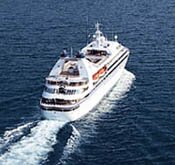
Even diminutive Seabourn "yachts"—at less than 10,000 tons—can't float onto a scale
|
How is a ship's weight determined? Ask a female to divulge her weight and measurements and you may get your face slapped. Quite the opposite is true of cruise ship "ladies"—their owners proudly display their dimensions in brochures and tout their size to entice passengers.
Have you ever wondered how they come up with those size statistics in regard to cruise ships? Length, from front to back, and beam, the measurement from side to side are simple matters; however, there isn't a scale on earth that a passenger vessel can float onto to determine her weight.
So, how do they "weigh" them? And why does size matter anyway? Armand Mantia is the one who explains it best.
Armand solves the weighty riddle: "This is probably the most confusing thing we ship junkies ever have to deal with, other than perhaps trying to justify the logic behind continuing the Passenger Services Act.
In the case of passenger ships, the word 'tonnage' is a measurement of space, NOT of weight. GRT (or Gross Registered Tonnage) measures the amount of enclosed space within the confines of the hull and superstructure. The problem is further complicated because there is no one universal standard of measurement for this. Americans measure gross tonnage by one set of criteria, the British use another, the Panama Canal has yet a third way for toll purposes, and the Suez Canal sets its own standard.
 |
|
Royal Caribbean's megaships weigh in at a hefty 160,000 tons (and more) of adventure
|
In order to find out what a ship would actually weigh if put on a gigantic bathroom scale, you need to ask for the 'displacement tonnage.' That is the amount of water 'pushed aside' by the actual weight of the ship sitting in it. The two are vaguely equal. If a ship displaces lets say, 50,000 tons of water, that is the actual weight of the steel, wood, aluminum, engines, etc., although the gross tonnage may be much higher.
Passenger ships are measured by gross tonnage, but naval ships are always measured by displacement tonnage. There is also a third measurement called 'deadweight tonnage' but let's not go there." ~ Armand
No matter how it's computed, size DOES matter!
How does your choice "size up" to other ships? Check the index of Cruise Ship Fun Facts for the stats.
Also factor in your lifestyle and expectations. Find out what you can anticipate in Cruise Line Profiles and Cruise Travel Categories.
More from CruiseDiva.com:
Articles & Advice
Cruise Reviews
Cruise Line Profiles